Showing posts with label Kilt. Show all posts

Tuesday, June 13, 2017

1745 Highlander Frock Coat


Here's the frock coat I made inspired by Colum MacKenzie's gathering coat.

I started with J.P. Ryan's 1750’s Coat with Military Variations for the Officer or Enlisted Man. I used the civilian coat cut a bit shorter than the length of the enlisted coat. The shorter length is made for riding horseback (unlikely in reality) and also to give enough room for my great kilt. I like the instructions provided with the pattern and the illustrations are good. It would be nice if there were videos to go with it, but I figured it out eventually.

As this is my first coat, I didn't want to spend a lot of money, so I used a 50/50 wool blend Melton fabric and cotton lining. The buttons are inexpensive ones found online from China. Instead of horsehair interfacing, I used a medium weight synthetic. I also saved money by using polyester buttonhole thread instead of silk twist and waxed cord instead of gimp. There is also none of the lace found on Colin's coat. The next coat will be tartan with silk or linen for the lining.

Machine stitched where it can be hidden and by hand wherever visible. The buttonholes are cut with a chisel and hand stitched with gimp cord and heavy polyester thread.

The buttons are pushed through holes for the button shaft made with an awl and held in place with twill tape. The tape is threaded through the shafts and sewn at each end inside the coat, between the outer layer and the lining.


Monday, April 13, 2015

State of the 'Stache: Five Months Later...

I've been pretty busy with a new job and our recent adventure into Steampunk (more about that later). The beard and moustache are coming along.

The 'stache requires quite a quantity of wax. I've settled on the dark version of Firehouse wax. The middle of the road as it were.

Switched from my barber to our friend who styles my wife's hair. She has more experience with long hair. Oh, I forgot to mention that I'm growing my hair long enough to queue and club. I'd like to venture into 18th century reenacting. In a kilt of course.

Well, here's the current look. The photo was taken at the second annual Gears, Beards, and Beers a Steampunk themed Beard & Moustache Competition hosted by Capital Steam and the Jackson Beard & Moustache Club (more about that later). On my left is my sister Lori and on my right is my wife Stacey.

I made the double breasted jacket from a modified McCall's Men's Civil War Costumes pattern M4745. I'll post construction instructions later.


Monday, October 14, 2013

Kilts and Such: Balmoral Bonnet #2

Note: This is actually a pretty old blog post. I'm on bonnet #6 now with a diced border. For some reason, Blogger goofed up this post and I had to delete and recreate it from scratch.

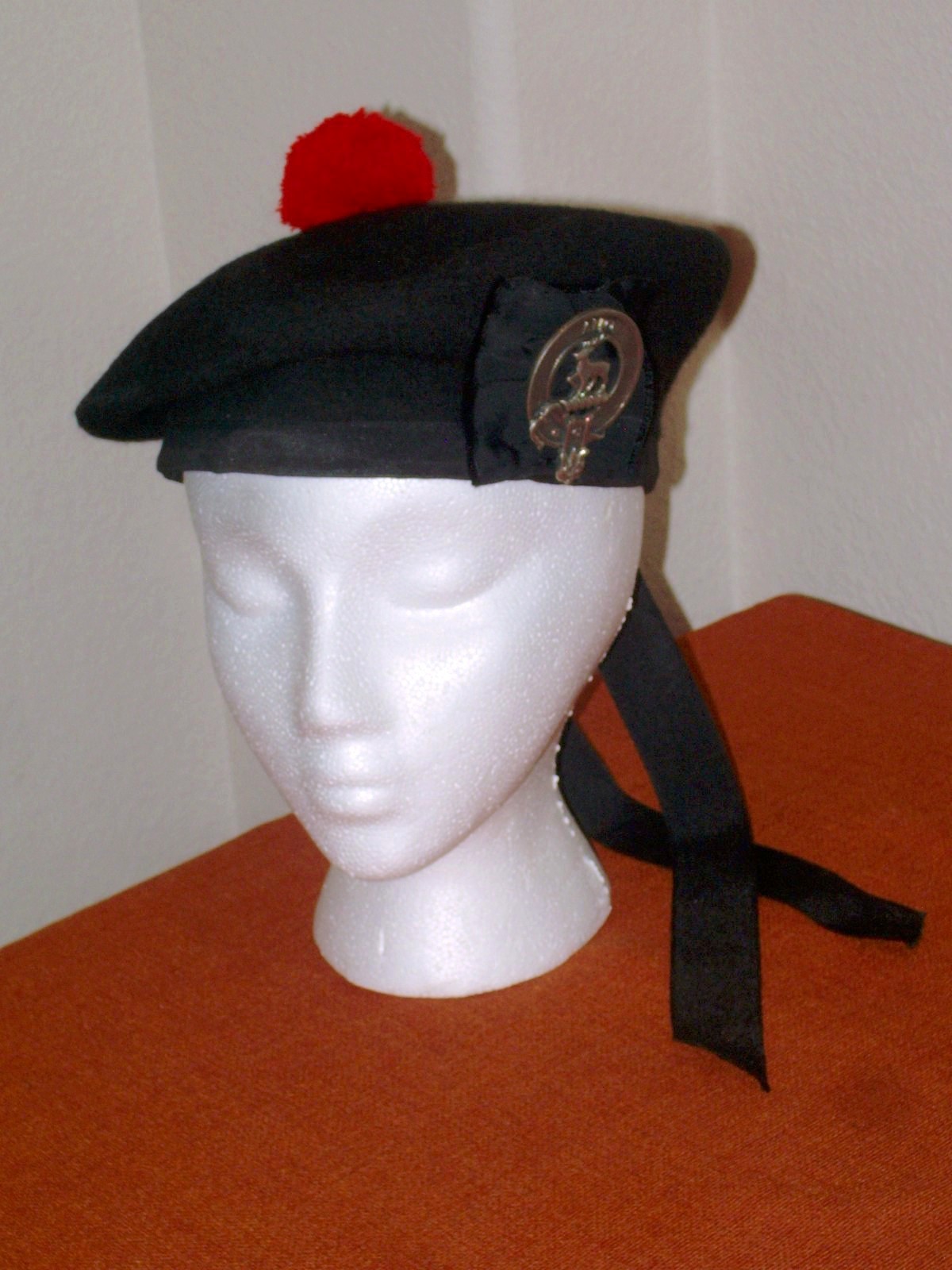
Balmoral bonnet #2 is finished. The yarn is Cascade 220. By far, Cascade 220 is the best yarn I've worked with. I understand why Anne recommends it in the Classic Highlander's Balmoral Bonnet pattern.

As with bonnet #1, the cockade design is from "So You're Going To Wear The Kilt" by J.Charles Thompson.

I used petersham cotton/rayon ribbon from Judith M Millinery Supply House for the head band and tails. Much softer look and feel. I really like it.

I used the medium size pattern instead of the large. My head is right on edge between the medium and large patterns. Unfortunately, felting the head band to the correct size resulted in a too small top. The slouch wasn't large enough.

Correcting this was fairly easy, just wet the bonnet and stretch it out.

Had to frog bonnet #3. The inexpensive black yarn proved to be very fuzzy after felting. It was also difficult to knit with. Maybe I can use it as a pouch or felted bowl?

The bonnet #4 is dark blue again in Cascade 220. I am extending the middle knit even rounds section from 4" to 5" or maybe half an inch more to add to the slouch width.

Before fulling/felting
After fulling/felting
After stretching the top to fit


Head band and ribbon

Cockade


Saturday, June 29, 2013

Kilts and Such: Knitting a Balmoral Bonnet

By SMcCandlish (Own work)
http://www.gnu.org/copyleft/fdl.html
I'm slowly building my kilt accessories both for casual wear as well as the Renaissance festival. One of the items I would like to add is a bonnet. From the several options available, I really like the look of a Balmoral bonnet.

If you google it, you'll find many places to purchase one. However, they are not inexpensive. I'm sure they are worth every penny, but I'm trying to keep within my budget which includes attending festivals.

My wife knits, and I casually mentioned my desire for a bonnet. To which she said, "Um...." To be fair, she has many knitting projects going on, several for other people, and I don't really want to ask her to take on another project. Besides, it's something I'm interested in, and the Saline Celtic festival is in a few weeks...

Learning to Knit
I decided to learn to knit. Stacey helped me look for a pattern, provided links to online training videos and resources, and best of all - she took time to show me the ropes (or yarn). This is significant since I'm the poster child for a difficult student. We both survived :-)

I started with a worsted weight yarn since this will be used for the balmoral pattern. Casted on using the long tail method, and practiced working flat with knit and purl stitches. I then made a simple toque using circular needles that ended up way too small. My stitches were way too tight and the gauge was at least 30% smaller than needed. As she feared, I was "man handling" the yarn. A second attempt produced a better toque, that was still 20% off but it was wearable.

Balmoral Bonnet Pattern
The Classic Highlander's Balmoral Bonnet pattern by Anne Carroll Gilmour was suggested by several members of X Marks The Scot forum.

Translating Knit-ish into English has been challenging. Once I approached it as if it were a computer programming language and graphed out as a series of nodes with decision paths and repetitive loops, it started to make sense.

After several false starts, I just finished the band and have started to increase the number of stitches to shape the bottom of the balmoral.

I'll post more as I complete it.

Finished Balmoral Bonnet #1
I used Lion Brand Yarn Fisherman's Wool. It's a very nice inexpensive yarn. My daughter picked out the ribbon colors.

The cockade design is from "So You're Going To Wear The Kilt" by J.Charles Thompson.

I have bonnet #2 in green (Cascade 220) felted and started knitting bonnet #3 in black. By far, I like the Cascade 220 yarn. You really do get what you pay for.  


Balmoral Bonnet #1

Traditional Bow

Cockade

Balmoral Bonnet #2


Monday, April 15, 2013

Kilts and Such: Sporran #2

Whether to Leather
There are a lot of leather sporrans out there. Not that there's anything wrong with that. I'm not a vegetarian and I enjoy venison although I'm not a hunter. My first purchased sporran is made from leather. Aside from the PETA argument, there are many who desire non-leather sporrans, either for the look or just to wear something different.

Leather Alternatives
I started searching the Internet for different sporran construction materials and examples. There a quite a few leather hybrid sporrans with different materials to cover the front panel or the flap. These still are primarily constructed from leather. Sporran Nation has many that are made from a vegan leather called Lorica. Some of the best examples I found were of sporrans either made entirely from tweed or faced with tweed. I've seen humorous and slightly disturbing versions using un-stuffed animals or other toys. Elmo never looked so good!

Tweed
According to Wikipedia, "Tweed is a rough, unfinished woollen fabric, of a soft, open, flexible texture, resembling cheviot or homespun, but more closely woven." It's a twill that is becoming a popular alternative to tartan for kilts. Harris Tweed is, in my opinion, tweed at it's best. Someday I'd love to have a Harris Tweed jacket or three, but it's pretty expensive stuff.

Just $3.00 from the Salvation Army!
I've found an awesome alternative source for tweed - recovered material from used tweed jackets. I can usually find several in excellent shape at the Salvation Army. There's quite a bit of material to be recovered, although the pieces are not large. The sleeves and back provide the most useful material. You do need to check the label to make sure it's 100% wool. Many are a wool blend or polyester.

I haven't run into any Harris Tweed jackets yet. If I did I'd probably put it up on Ebay rather than harvest cloth from it. It'd be a shame to disassemble on.


Sporran #2
My first sporran was a simple Rob Roy style made with pleather. It was okay for my renaissance fair outfit, but isn't going to last very long. For my second sporran, I'm using duck canvas as a foundation for the inner lining, with a plastic canvas interfacing, a tweed outer lining, all sewn together with upholstery thread. The gusset will be a single layer of duck canvas.

Since this is a construction experiment, I'm going to copy the pattern from my cheap stiff leather sporran. It's provided great service for the price, but it's less than a year old and I've already had to re-stitch sections of it.

Interfacing
I traced a pattern from the cheap sporran onto stiff card, cut them out, and used them and an x-acto knife to cut out plastic canvas for the front and back panels. The back panel also includes the top flap.

Pattern and plastic canvas inner lining.
Inner Lining
As with my doublet construction, the same pattern is used to measure the black canvas inner lining adding an extra three quarters of an inch around the pattern to wrap around the plastic canvas.

Duck canvas with pattern traced in chalk. Cut 3/4 inch around markings.
Using barrettes to hold the layers together didn't work as well as with the doublet, due to the inflexibility of the plastic canvas. Later, I brushed a think layer of tacky glue onto the plastic canvas to hold the tweed in place so that it wouldn't distort. If I use this material again, I'll do the same with the duck canvas. However, I may switch to a heavy fusible interfacing.

Sewing the inner layer of duck canvas to the inner lining.
Normally, I'd sew the outer lining to the interfacing with a stitch that's hidden from view. Unfortunately, the plastic canvas doesn't lend itself to this. At least the black duck canvas hides the stitches well. Another reason to use fusible interfacing.

Outer Lining
After stitching the duck canvas, I once again attempted using barrettes on the tweed out lining. With three layers, the barrettes failed to stay closed. The tweed also proved to be so flexible, it distorted while holding it. I removed the barrettes, brushed a thin layer of tacky glue to the plastic canvas, and pressed the tweed down into the correct position. A few minutes later, it was ready to trim and sew.

Tacky Glue to the rescue!

Turn the tweed edge under facing the interfacing layer and stitch the tweed to the duck canvas along the edge. This was much easier than the duck and plastic canvas layer. Instead of the upholstery thread, I used a thinner polyester. A tight whip stitch along the edge took no time at all and is virtually invisible.

Whip stitching the tweed and canvas together.

The finished panel looks pretty good. As I said earlier, I'd rather not show any stitches at all. If I had used thick fusible interfacing or a heavy hair canvas instead of plastic canvas, I could have avoided the stitches in on the inner lining. At least the outer lining hasn't any exposed stitches.


Inner lining in duck canvas. Please ignore the stitching ;-(


Outer lining in tweed

Belt Loop
I considered several options for the belt holder on the back of the sporran. For example, sewing a pair of "D" rings to the back. Since I want to compare the performance of this sporran with my cheap leather one, I decided to construct a belt loop.

I used the same construction as the front and back panels, and attached the loop with the duck canvas facing toward the front of the sporran, assuming it would get the most wear. A double row of upholstery thread sewn through to the six layers of belt loop and back panel should hold. I found sewing through the plastic canvas a bit of a challenge. I tried to follow the curve of the belt loop and kept running into plastic. I was able to reposition the needle most of the time, but with two layers of plastic canvas, the holes sometimes just don't line up where I need them. Yet another reason to use fusible interfacing.

Belt loop attached
Gusset
I've decided to use a button and loop as a latch. I should probably sew them on before sewing the gusset to the back and front. Since my gusset is pretty wide, I'm going to wait so I can optimize their placement.

The gusset is a double layer of duck canvas, sewn together and turned inside out to hide the seam. Although I could have used the sewing machine to do this, the rest of the sporran is hand sewn so I took the time to hand sew it. Didn't take long.

To give me some room for adjustment, I left one end of the gusset unfinished. The gusset is sewn to the front panel so that it can be reversed, giving the front a smooth roll of cloth and a hidden seam. When sewn to the back panel, the gusset forms an "S" shape encouraging it to fold inward when compressed.

Sew the gusset to the outside of the panel

More sewing o' the gusset
After sewing the gusset to the front panel and reversing, I noticed that the rolled edge doesn't stay in place as well as the leather. Normally, when attaching a leather gusset, the leather is dampened to encourage it to stretch and form a nice rolled edge. Which, of course, I cannot do with the duck canvas. I thought it was going to stay once it was sewn to the back panel. I ended up stitching the top portion of the roll to the inside edge of the front panel about half inch an inch down to encourage it to stay rolled. Now would be a good time to do this.

Gusset rolled toward inside of front panel
View of rolled gusset from the front panel
Before sewing the gusset to the back panel you will want to line up the two panels so that they are parallel to each other and not rotated, then mark the top edge of the gussets to the back panel with chalk. I also pinned the gusset to the back panel to keep it from rotating while sewing. It still was off a bit and I had to make some adjustments to the top edge of the gusset to keep it from looking higher on one side relative to the other.

I think it would have been better to have found the exact bottom of the gusset relative to the front panel and started sewing it to the back from their. Using two needles and thread, progressing from the bottom toward the top edge. This would have probably helped keep the finishing position from sliding higher. At least it wasn't too far off.

Finishing the edge of gusset off


Tacking the roll to the panel to encourage it to stay rolled
Wide and deep
Closure
With such a wide gusset I was concerned with latch placement. Sporran #1, the Rob Roy style, has a loop and knot closure that is a bit annoying. To keep it closed, you have to tie the loop, otherwise it cannot be adjusted for the volume of stuff you're carrying around. I was afraid this would be an issue. If you collapse this sporran flat, the top flap extends a good two inches farther down the front panel than when fully extended.

As a compromise, I attached two buttons, one to the flap and one to the front panel just far enough that it won't get in the way when the sporran is fully collapsed. To allow for adjustment, I'll tie a cord to the top button, and loop a cord around both buttons in a figure eight pattern. The friction looks like it will be enough to hold it without a knot. I'll give it a try for a while and see how it works out. I can always change it later.

Two button with cord closure

Friday, December 28, 2012

Recent Acquisitions


My family has spent Christmas at the Bavarian Inn Lodge and Restaurant in Frankenmuth, MI for years. It's become a family tradition. The inn is reasonably priced and close to home. Only takes us an hour's drive.  The inn also has several indoor pools, a water slide, put-put golf, and game room. This is nice when the weather is nasty, we can stay indoors at the inn and still have some family fun time. The restaurant has a great family style broasted chicken dinner that is to die for. My son would eat the bowl of buttered noodles alone if we let him.

Downtown Frankenmuth has lots of shops but by far the best known is a huge Christmas store called Bronner's CHRISTmas Wonderland. The store is so huge, they measure it in football fields. It's five and a half football fields of indoor sales floor space, all in one building.

This was this year's first purchase.

THIS is how Santa looks in our home.

I also found this kilted Santa but passed on purchasing it. Maybe next year.


Wednesday, October 31, 2012

Things From My Desk: Star Trek Phaser


Star Trek is, without a doubt, my all-time favorite science fiction television program. Especially, the original series.

When they started promoting the latest movie, you could get a free Star Trek uniform shirt from Kellogg for a certain number of box tops. I cannot remember exactly how many, but I purchased enough Corn Flakes to start a survival shelter. Enough to get four shirts for my family.

Sean wasn't interested, but I got him a gold command shirt anyway. I've always wanted to be an engineer, so mine is read. I think Stacey and Lydia wanted medical and science (blue).

Today at work we had a Halloween dress up day. I was out of the office at a Microsoft sponsored event this morning so the kilt was out. Instead, I just dressed in a t-shirt and black jeans and tossed my Star Trek shirt and cheap costume phaser into my bag. A simple shirt change back a the office was all that was necessary.

Someday I'll spend the money on some TOS props. A hand phaser, tricorder, and communicator. I also think I'll make a Wrath of Khan style uniform jacket to go along with my kilt. Scotty didn't wear one in the movie, but a fan must have put one together judging from the image below. He did wear one in an episode of the original series. Not the same tartan as below but I think the MacQueen colors complement the uniform jacket.

Best of both worlds :-)

+ =

Sunday, September 30, 2012

Féileadh Mòr - Kilt Hose

Not too shabby
I made kilt hose from flannel "tartan"cloth. Unfortunately, wool tartan cloth is just too expensive for my Renaissance Faire garb. I'm sure some historical reenactors would say flannel is probably one of the worst fabrics I could pick, but it was the only thing available at a reasonable price. My great kilt requried at least eight yards of cloth. Someday, I'd love to make my garb from vegetable dye homespun wool - someday.

Since these hose are not knit, you need to cut on the bias so the fabric has some stretch. Don't bother trying to find a pattern. The easiest way to make them is to drape some scrap fabric around your leg and foot, pin it, and trim. You want to trim fairly close and with the seam along the back of your leg. Sew up the scrap, try them on, sew them a bit closer to take up any slack, and repeat. Stand with the pattern on to make sure you can flex your foot. If you trim too closely, you'll put too much stress on the heel. Resist the urge to cut out the bunched fabric on top of your ankle, I'll explain later.

When you've sewn them as close as you can, trim the excess fabric close to the seam. This will simplify tracing them onto papper to make a pattern. Give your pattern a half inch margin for the seam. This will give you some extra fabric to adjust the fit. It's much easier to cut excess fabric off than to add it back on.

My customized tartan kilt hose pattern
You'll notice the pattern is a single piece and does not have a seam in the front. The seam runs along the back. This keeps any mismatch with the tartan pattern along the back of the leg, under the foot, and over the toe. You want to place the pattern on your fabric with the long axis (this becomes the front of the hose) aligned along the bias of the fabric. With a tartan, especially one with a square pattern, this is easily accomplished by lining up corners in the pattern. 

If you are careful, you can pin the fabric along the back seam to match the tartan pattern. To get it right, the edges of the fabric might not be perfectly aligned, but the pattern has enough play in it to take this into account.

The bias cut fabric will be a lot stretchier than what you may be used to sewing. My scrap for the pattern was muslin and not cut on the bias. I found that I needed to sew the seam closer than the pattern to take up the slack. When you're done, just cut around your seam leaving about 1/4 inch of fabric. I used a straight stitch and went over it again to strengthen it a bit. Unless you had to cut a huge edge of fabric off, don't bother adjusting your pattern. You never know how stretchy the fabric for your next pair will be. Again, it easier to cut off excess fabric than to sew it back on.

Tartan kilt hose
I used some short pieces of jute to make simple garters to hold them up. Genetics and karate have given me fairly decent calves, so the twine did not need to be tight and they stayed up all day. Fabric will bunch over the top of the ankle, but it's not much and didn't bother me. Trimming to eliminate it would disrupt the tartan pattern.


Saturday, September 29, 2012

Féileadh Mòr - Shoes

Ballyhagan, Drumacoon, Pampootie, Cuaran, and Rivelins are early bag shoes that were worn by Scottish Highlanders. Made from a single piece of rawhide leather, they were simple to make and easily replaced. All you need is a source of leather, a knife to cut out the shape needed and to cut holes and strips of leather for lace.

I started with a Ballyhagan/Pampootie style pattern made from an image found at http://www.personal.utulsa.edu/~marc-carlson/shoe/SHOES/SHOE57.HTM. It is gathered at the toe (and along the sides in the Ballyhagen shoe) with an open vamp. Holes were punched into the edges to let water work it's way out so the foot can dry out. Since the pattern wasn't very clear, I made a couple of scrap fabric versions, making adjustments as I went. 

I picked up a leather coat from the Salvation Army for $15 for the leather and some foam arch support shoe inserts to substitute for the grass or felt that would have been shoved into the shoe to give the user some support. I'm not entirely happy with the way they came out. The inserts shift around a bit and I'm not sure they'll work well. I tried lacing across the vamp to tighten it up, but the leather wasn't strong enough to support laces and tore through the holes. I might make a closed vamp shoe more like the Drumacoon. 

Shoe leather punched and ready to go
Ballyhagan

I also have a pattern for a later period latch style short boot (Butterick pattern B5233). I tried making a scrap version, but the largest size is too small for me. It fit my wife, so it's probably a women's size eight or nine.

After adjusting the pattern to fit and making a few minor modifications, I managed to get the boots done for the last weekend of the Michigan Renaissance Festival. Instead of the dodgy loop stay from the pattern, I added a grommet to the flap and tied it with some leather strap sewn into the back. They held up rather well. I thought they would fall apart halfway through the day, but they didn't. The boots looked pretty good, but slipped too much and didn't provide enough support.

I'll sew a layer of material to the bottom to add a thicker sole and use them for my sister's Halloween party, but I'll buy proper short boots before next year's festival. Finished leather if I can find some reasonably priced. If not, suede and try to keep them clean.

After a long day at the faire

Sunday, August 26, 2012

Michigan Renaissance Festival - Got Kilt?

I'd forgotten how much fun the Michigan Renaissance Festival can be.

Stacey and I haven't been in quite a few years (13 or 17 - she was pregnant with either Sean or Lydia at the time). Lydia and Sean have never been. Stacey asked Lydia if she'd like to take a couple of her friends for her birthday. Usually, she has her friends go camping with us but that didn't work out this year.

Warrants of Arrest
for
"Sweet Entertainment"
 "Beatlejuice x 3"
and
"Revenge"
I received two Warrants of Arrest thanks to my lovely daughter and her friends. The first for Notorious DAD and again for Bein' Eveeeil.

The girls took off to spend some quality time with each other. Our paths crossed several times - at one point Lydia acquired Elf ears and Emily sprouted horns.

We didn't see as much of the stage acts as we'd have liked but did get to see some of the Scottish Dancers and US Canadian Highland Heavy Games. We saw the Braemar Stone Put (like the shot put but with stones), Caber Toss (flipping a tree length pole end-over-end for distance and accuracy), and 56lb. Weight for Height (iron weight on a short chain tossed one handed, over head, and over a horizontal beam).

Sir I-Can't-Remember-His-Name with Sean and Stacey


We saw the Roundtable Productions Joust, which Sean enjoyed. Sean also liked the glass blowing where he bought a glass paperweight. He also wanted to see the blacksmith demonstration, but they wouldn't be demonstrating until late that day so he missed it.

The Black Watch
3rd Battalion
Royal Regiment of Scotland 
I've always wanted to get a kilt, and almost bought one from Got Kilt. Not wanting to offend, I was looking at a Black Watch tartan, a tartan that anyone can wear, but there wasn't one readily at hand in my size.

Stacey and I are planning to go back Labor Day weekend without the kids, so I decided to wait until then. This turned out to be for the best. I remembered last night my maternal grandmother's maiden name is MacQueen (or MacQuien if you look at census data). The only down-side is that it requires a special order and will take longer. But, I should get it in plenty of time for my sister's annual Halloween party. Stacey is now looking at suitable attire to complement a kilted Scotsman.

I think the RenFest will become an annual event for us from now on.